
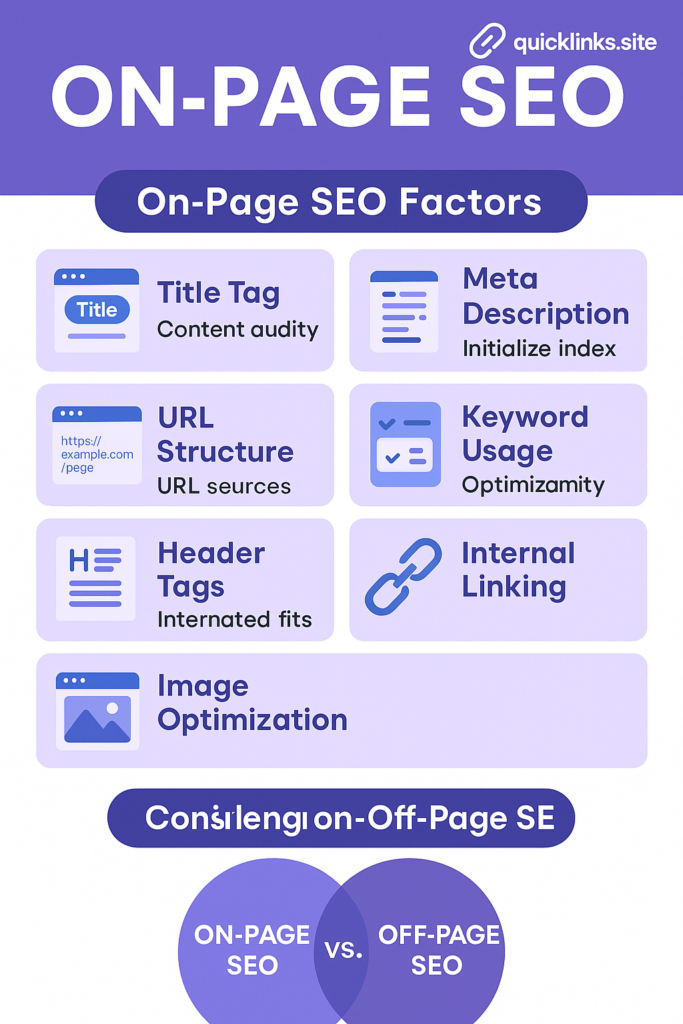
Introduction:
In a fast-moving digital environment, it’s not enough to build a website. Your website must be found. On-page SEO is all about improving the visibility of individual pages on your website in search engines to bring engaging, relevant traffic. There are a host of on-page SEO tools we can use, each of them significant – from powerful meta titles and headers to placement of keywords, optimization of images, internal linking and a lot more. Great on-page SEO includes those fine details of technical adjustments, but great on-page SEO is also about real value for the reader. At the end of the day, great on-page is all about content that is entertaining, trustworthy and easily accessible. This article highlights several fundamental strategies for strong on-page SEO, as well as best practices for improving your website performance and navigating through the search minefield.
Understanding On-Page SEO:
On- express SEO implies to the moves gripped especially interior the emplacement to form strides in its function in experience order. This incorporates optimizing substance, HTML source code, and in general client involvement. Not at all like off-page SEO, which includes outside components like backlinks, on-page SEO is completely inside the control of the site owner.
ON-Page and OFF-Page SEO: What’s the Difference?
Search engine optimization or SEO is a vital part of digital marketing, including two central parts: on-page SEO (optimizations directly on your website) and off-page SEO (external influences on your website authority). Understanding the differences of each method will assist in creating a complete SEO strategy that brings in organic traffic and increases search rankings.
This guide will focus on the primary differences between on-page and off-page SEO, components of each and how to make the best use of both tools.
What Is On-Page SEO?
On-page SEO encompasses every optimization that you make internally on your site to improve its visibility in search engine results. Since these elements are fully under your control, you can improve user experience, and SEO bot’s crawlability.
Key Components of On-Page SEO
High-Quality Content
- Content must be original, relevant, and of value to readers.
- Effective keyword placement (natural use, not stuffing).
- Clear organization using headings (H1 for title, H2/H3 for subtopics).
Meta Tags & Descriptions
- Title tags (less than 60 characters, including target keywords).
- Meta descriptions (less than 160 characters, enticing and click-worthy).
URL Optimization
- Short, descriptive, and keyword-packed URLs (e.g., yoursite.com/seo-strategies).
Internal Linking
- Linking to relevant pages to enhance navigation and spread page authority.
Image & Multimedia Optimization
- Alt text for pictures (assistive and SEO benefit).
- Compressed files for rapid loading times
Technical SEO
- Page speed (optimize with utilities such as Google Page Speed Insights).
- Mobile responsiveness (high priority for ranking).
- Schema markup (improves rich snippets in search engine results).
What Is Off-Page SEO?
Off-page SEO comprises external aspects that standard your site recognition and respect. Note that off-page SEO elements have less control than on-page SEO optimization, and therefore, that’s what makes it relatively harder to optimize.
Key Components of Off-Page SEO
Backlinks (Link Building)
- Quality over quantity: Lower-quality links from variety of authoritative sources (Forbes, HubSpot) carries different weight.
- Bad or spammy links should be avoided since they could hurt your rankings.
Social Media Engagement
- You could say your social media engagement – active engagement can take place on Facebook, LinkedIn, Twitter, etc.
- Honestly, social shares can offer indirect visibility and referral traffic.
Brand Mentions & Citations
- Even unlinked brand mentions can add credibility.
- “Local SEO,” citation is important for businesses with physical addresses.
Guest Blogging & Influencer Marketing
- Guest posts on reputable sites can provide solid backlinks.
- Or, collaborate with influencers to “amplify” your content.
Online Reviews & Reputation Management
- Collecting positive reviews on Google My Business, Yelps or Trustpilot.
- And professionally addressing negative feedback.
On-Page vs. Off-Page SEO: Which One Is More Important?
Both types of SEO are important but they each serve separate purposes:
Factor                                        On-page                                   SEO Off-page SEO
Control                               Total control                                   Almost no control
Primary            Focus Content & technical optimizations    Authority & trust signals
Impact                    Speed Speedy results                                 Long-term growth
Why You Need Both
On-page SEO makes sure that your site is technically correct and user-friendly.
Off-page SEO increases your credibility and assures search engines that your site is trustworthy.
Both are necessary – Start by optimizing your site (on-page) and then create authority signals (off-page).
Conclusion:
To achieve long-lasting SEO success, you will be required to succeed at on-page and off-page SEO. On-page SEO is where it all starts in order to enhance the content, structure, and technical aspects of your website, and off-page SEO can then play its part in improving authority via backlinks and social signals as well as brand reputation. By adopting an effective SEO strategy you will increase the chances of establishing higher rankings, gaining more organic traffic, and establishing your online presence as a credible source in your industry.
Key Components of ON-page SEO
1. Watchword Research:
Effective on-page SEO starts with careful keyword investigation. Distinguish important catchphrases that your target group of onlookers is looking for. Use tools like Google Catchphrase Organizer, Ahrefs, or SEMrush to catch on passwords with an expert acclimate of keyword research and competitors.
2. Title Tags:
It ought to be one of a kind, clear, and incorporate your essential catchphrase. Point for a length of 50-60 characters to guarantee it shows legitimately in look results.
3. Meta Descriptions:
Meta descriptions give a compact rundown of a webpage’s content. Whereas they don’t suit straightforward reach orderings, an effective meta sketch can develop related qualities.
4. Header Tags:
Header labels (H1, H2, H3, etc.) offer assistance to organize content and move forward lucidness. Utilize H1 for the essential title and H2 for subheadings. Join the keywords actually inside these labels to improve SEO.
5. Substance Quality:
High-quality, significant content is basic for on-page SEO. Make instructions, lock in, and a unique substance that addresses the needs of your gathering of people. Point for a word check that gives comprehensive scope of the theme, regularly 1,000 words or more.
6. Catchphrase Placement:
Consolidate your target watchwords regularly all through the substance. Center on the to begin with 100 words, headers, and the conclusion. Dodge catchphrase stuffing, as it can lead to punishments from look engines.
7. Inner Linking:
Inside bangers affiliate different runners inside your point, manufacturing a dissimilar visage engines learn the building and string of your content. Use visual scuffle content and band to express couriers to perfect guest involvement and SEO.
8. Picture Optimization:
Illustrations can ameliorate guest espousal, but they overly want to exist optimized for SEO. Utilize clear record names and alt labels that incorporate significant keywords. Compress pictures to improve stacking speed.
9. URL Structure:
A clean and graphic URL structure is vital for both clients and look motors. Utilize hyphens to divide words and join your fundamental catchphrase.
10. Mobile-Friendliness:
With the expanding utilization of portable gadgets, having a mobile-friendly site is essential. Ensure your area is responsive and gives a reliable experience across all devices.
11. Page Speed:
Express piling quickness is a fundamental numeric for customer skills and SEO. Utilize devices like Google PageSpeed Experiences to analyze your site’s speed and execute suggestions to make strides.
12. Client Encounter (UX):
A friendly guest involvement can lead to minor go qualities and progressive espousal. Center on a natural route, clear calls to action, and an outwardly engaging plan to upgrade UX.
ON-PAGE SEO Checklist
Search engine optimize your page using this on-page SEO checklist: Target one main keyword within the title, URL, H1, and meta description. Organize content with clean headings (H2-H3) and insert relevant keywords organically. Optimize images (alt text, compressed files) and have them load quickly. Enhance UX with mobile responsiveness, internal linking, and readable formatting (short paragraphs, bullet points). Insert schema markup for rich snippets and update content regularly. Here are the steps to increase rankings and organic traffic successfully.
- Keyword Research
- Content quality
- Keyword Placement
- Images
- Title
- Headings
- Meta Description
- URL
- Links
- Technical Optimization
- Content Freshness
- Schema Markup
- Readability & Engagement
- User Experience & CTR Optimization
- Regular Update
Keyword Research
Good keyword research is the core of any well-executed SEO plan. Begin by determining search intent—discover what your potential customers are trying to find. Utilize instruments such as Google Keyword Planner, SEMrush, or Ahrefs to establish high-volume and low-competition keywords that apply to your materials. Examine competitors’ head pages for empty spaces and windows of opportunity. Target long-tail keywords foremost for improved aiming and greater chances of conversion. Cluster similar terms into topic clusters for a content-structured approach. Update your keyword list periodically based on trends and performance metrics. A data-driven keyword strategy guarantees visibility, relevance, and organic growth over time.
Content quality
Quality content fixes issues, responds to questions, and holds readers’ attention. Prioritize original thinking, concise organization, and organic readability—no fluff. Employ brief paragraphs, subheadings, and images to support UX. Align with search intent while providing additional value over rivals. Edit for mistakes and write conversationally. Google favors depth, expertise, and relevance, so write quality over quantity. Regularly update to remain accurate and authoritative. Excellent content generates trust, shares, and rankings.
Keyword Placement
Using keywords strategically means placing keywords where search engines can easily find them, but this also needs to feel natural and enjoyable for readers. Your primary keyword should be among the first 100 words of your content, in your title, H1, and meta description. Use secondary keywords and synonyms sparingly in other headings (H2-H3) and body text. Avoid keyword stuffing. It is more important that it all looks good first; the keywords should flow naturally within valuable content. Place keyword optimization behind user experience, and the page will have better visibility on Google.
Images
Images make your content enticing and boost your SEO when optimized. Use high-quality images that relate to and help clarify your message. Compress your images (use WebP file type when you can) to improve load speeds, which is critical for user experience and site ranking. Alt text should always be included and should have the target keyword naturally inserted into the descriptive text if possible to help search engines and users understand your image. Use a clear filename for your images (healthy-smoothie-recipe.jpg). If you’re really looking to score points with SEO, you can add captions and add text/context around each image (it all counts) Images that are optimized will entice your readers and will also help your page with search performance as well.
Title
The title is your first impression for users and search engines. You want to keep it around 60 characters or less, so that it does not get truncated in search results. Use your main keyword close to the beginning of your title while also making certain the sentence flows well. Consider using power words like “Ultimate”, “Proven”, or “Essential” to encourage a click. Make sure the title reflects what is in your content to better satisfy user intent, and to minimize your bounce rate. Once you have written your title, consider testing different versions of it to see how it performs. A title which is well-optimized helps with visibility and also makes your content more enticing to click on.
Headings
Headings (H1-H6) establish content hierarchy and enhance both UX and SEO. Your H1 must be distinct, have the main keyword, and include the page title. Utilize H2 for major sections and H3s-H4 for subtopics, organically incorporating related keywords. Make headings concise (less than 70 characters) and skimmable so that readers can easily navigate through them. Headings are read by search engines to determine the structure of content, and well-formatted formatting makes it accessible. Well-designed headings increase engagement and provide your content with a competitive ranking advantage.
Meta Description
Your meta description is an advertisement in the search results – make it impactful. Use 120-160 characters so it doesn’t get truncated. Begin with a compelling hook referencing user intent, which should include your key word naturally. Emphasize what’s distinctive about the page using action words (“Discover,” “Learn,” “Get”). Not a direct ranking signal, but a well-crafted description enhances CTR, which indirectly increases rankings. Write for humans first, but keep in mind: this snippet decides whether people click through to your page.
URL
A tidy URL structure enhances user experience and search visibility. Keep URLs short, readable, and descriptive – ideally under 60 characters. Place your main keyword towards the start, separating words with hyphens (e.g., /seo-best-practices). Refrain from numbers, parameters, or stop words (and, the) that introduce clutter. Mirror your page title in the URL where possible for consistency. Organized URLs assist search engines in comprehending your content while making links shareable and trustworthy to users.
Links
Links are the connective tissue of your website – they help your users and search engines navigate your content. For internal links – use keyword-rich anchor text that naturally fits within the context of your writing (like don’t use “click here”). Use external links to established authority sites for credibility, but do this sparingly. Use only links that open in the same tab (except downloads), and regularly check for broken links. If you connect your links together properly, you can improve crawlability, distribute page authority, and keep your visitors on your site longer. Remember – every link you share should have a purpose to help your reader first.
Technical Optimization
Technical optimization is a critical step that guarantees search engines can appropriately crawl and index your site. In summary, it creates a smooth site experience for users and search bots. Focus on core web vitals by optimizing loading speed, removing/render blocking resources and ensuring you have a responsive mobile site, along with adding a well-defined XML sitemap and robots.txt file, to produce an optimal crawl for search engines. Ensure that you are employing canonical tags appropriately to deal with duplicate or similar content. Engage HTTPS security, and get rid of all 404 errors. Also, remember that structured data markup helps search engines better understand what your content is about.
Content Freshness
Search engines prefer up-to-date content that is reflective of present information. Update older blog posts by including new data, stats, and examples to ensure accuracy. Date-stamp updates when making major changes, yet avoid “false freshness” with minor updates. Produce evergreen content of enduring value while checking occasionally for stale references. A content calendar keeps your content current and authoritative. New content notifies search engines about quality and ensures readers return for accurate, fresh information.
Schema Markup
Schema markup improves search engines ability to understand your content which in turn can unlock rich snippets in search results. Utilize the JSON-LD format to highlight key features like products, reviews or frequently asked questions. Improving of your CTR is an important, however most important is by properly implementing Schema Markup provides search engines additional data without directly impacting the rankings. For maximum results, focus directly on the relevant types available (i.e. Article, LocalBusiness, Event). Change what you need to ensure the code is clean, compact, and maintainable. Use Google’s Rich Results Test to test your implementation. Even though implementing Schema can be technical it is a powerful way to stand out in search. Implement it correctly and improve visibility, click-through rate and engagement from real users!
Readability & Engagement
Strong readability turns visitors into active readers. Write concise, skimmable copy in short paragraphs (2-3 lines), bullet points, and everyday language. Use descriptive subheadings and visuals to break up text and direct the eye. Speak directly to readers (“you”) and mix sentence lengths for rhythm. Products such as Hemingway Editor ensure that content remains at an accessible grade level. When copy reads naturally and captures attention, it lowers bounce rates and conveys quality to search engines—while truly serving your audience.
User Experience & CTR Optimization
An excellent user experience generates clicks and keeps visitors on the site. Use a clean layout, logical navigation, and a fast page load time. Write well-constructed and engaging meta titles and descriptions that promise value using power words to improve click-through rates. Use clear calls-to-action and place them above the fold. Ensure mobile compatibility. Provide relevant content that is easy to scan to reduce bounce rates. When visitors obtain what they need quickly, they will stay longer; this increases the dwell time which will help with rankings. Optimize for humans first, and search engines will follow.
Regular Update
Search engines like fresh and accurate content. If you refresh your content regularly, it shows your information is current and trustworthy. I encourage you to go through previous posts every three months, and I want you to refresh statistics, incorporate examples, and clean up old information. You should only change publication dates if you make substantive adjustments. Ensuring pages remain fresh helps your overall search paragraphs typically maintain reader confidence. If you put a content audit in place, it below the surface keeps your material competitive. Prioritizing being and refreshing content helps prolong the lifecycle of your information and your authority.
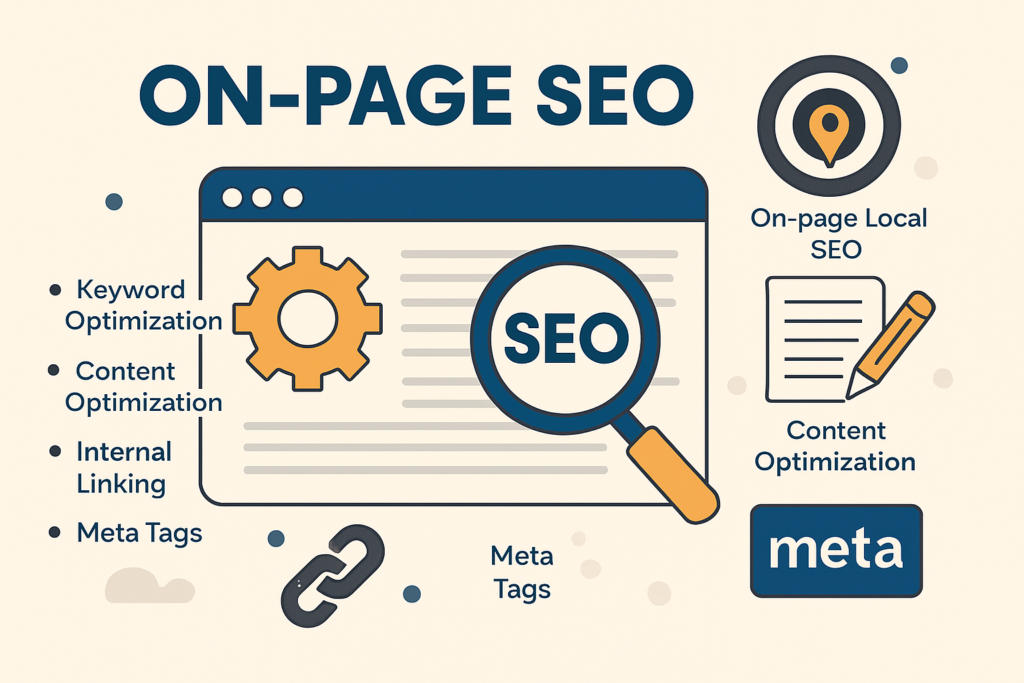
FAQs on-page:
This report gives a comprehensive outline of regularly inquired questions (FAQs) related to on-page SEO. On- messenger SEO alludes to the niche of optimizing person trap expresses to position progressive and score too expressive exercise in visage engines. This direct points to clarify common inquiries and give noteworthy experiences for moving forward on-page SEO strategies.
What is on-page SEO?
This incorporates components such as title tags, meta descriptions, header labels, and the by and large substance structure. The objective is to make the page more significant to look at inquiries and make strides in its visibility regarding search results.
Why is on-page SEO important?
On-page SEO is significant since it makes a difference when search engines get the content of your page and its significance to client inquiries. Legitimate optimization can lead to higher rankings, expanded natural traffic, and improved client experience.
What are the key components of on-page SEO?
Key components of on-page SEO include:
Appellative markers: The handle of your webpage that shows up in the search results.
Meta delineations: A thumbnail rundown of the messenger making that shows up underneath the handle in visage sequences.
Header Labels (H1, H2, H3, etc.): Utilized to structure content and show the pecking order of information.
URL Structure: Clean and graphic URLs that reflect the substance of the page.
Keyword Optimization: Deliberately putting pertinent watchwords all through the content.
Image Optimization: Utilizing alt labels and fitting record names for images.
Internal Connecting: Connecting to other pages inside your site to upgrade the route and context.
How do I select the right catchphrases for my on-page SEO?
To select the right keywords:
Research: Utilize keyword inquiry about apparatuses to discover pertinent keywords with great search volume and moo competition.
Relevance: Guarantee the watchwords are significant to your content and audience.
Long-Tail Catchphrases: Consider utilizing long-tail keywords, which are more specific and frequently have less competition.
How often ought I to overtake my courier SEO?
Regular upgrades to your on-page SEO are prescribed, particularly when you include unused content, alter existing content, or upgrade search engine algorithms. Celebrating your material, makeshift, and much can support you to celebrate or disturb along in your scales.
What’s the take on account involvement in on- go-between SEO?
stoner skills( UX) play a judgmental role in on- express SEO. Variables such as page stack speed, mobile-friendliness, and simple route can affect how clients connect with your location. A friendly UX can show to less energy grades and advanced truth, which are positive flags to make machines.
Can I do on-page SEO myself?
Yes, on-page SEO can be done by anyone with a basic understanding of web content and SEO principles. There are many finances and instruments available to support you in picking up and executing operational on express SEO plans.
Conclusion:
On- courier SEO is an proceeding operation that requires frequent updates and optimizations. By implementing the strategies outlined in this guide, you can improve your website’s visibility, attract more organic traffic, and ultimately achieve better rankings in search engine results. Flash back that SEO is not a one- moment assignment but a running work to suit remaking algorithms and addict comportment.
QUICK LINKS Team Work:
Quick Link Teamwork is an active model of collaboration for enhancing productivity and communication . Through the centralization of vital resources and tools via rapid access links, teams are able to effectively traverse tasks and customize them towards objectives. The system reduces time spent looking for information and enables greater strategic work focus. Team members are able to simply share updates, delegate responsibility and chase progress in real time. . In the office or remote control, they bridge the gap and keep everyone together. Collaboration is effortless and fosters innovation and mobility. Quick left teamwork is the answer to quicker decisions, tighter teamwork, and measurable outcomes for SEO Strategies.